March 06, 2026
Accelerating Technology Modernisation with Practical Cloud Migration Playbook
Executive Summary
Context: A major Financial Institution needed to exit data centres, reduce risk, and modernise fast.
Scale: ~3,000 applications targeted over ~4–5 years across multiple public cloud providers.
Approach: Portfolio‑driven prioritisation, repeatable patterns, and tight feedback loops between platform and delivery teams.
Result: Faster migrations with clearer decisions, improved resilience and security posture, and a runway for AI and data capabilities.
Client Context
A leading Australian financial institution embarked on a multi-year transformation program to modernise legacy systems, enhance operational resilience, and adopt multi-cloud at enterprise scale.
The strategic goal was to exit on-premises data center, simplify the technology landscape, reduce operational and compliance risks, and build an automation foundation with platform mindset. The immediate, tactical goal, however, was to migrate complex, heterogenous portfolio of applications to cloud within a tight timeline of ~4-5 years adhering to required compliance, without losing control.
Objectives
- Exit data centres and simplify the tech estate.
- Reduce operational and compliance risk.
- Establish a platform mindset with automation and patterns.
- Deliver migrations at pace while protecting critical services.
With diverse nature of workloads, objectives were conflicting for a subset of workloads.
My Role
As a Senior Cloud Architect (Multicloud), my engagement spanned the full transformation lifecycle, from portfolio strategy and architecture governance through to delivery feedback loops and platform uplift, with a specific focus on making complex tradeoffs defensible and decisions traceable. I was engaged within the program’s strategic direction and technical execution. During my engagement in migration program, I was engaged in the following activities:
- Designed and reviewed cloud architectures and standard migration patterns.
- Prioritised platform readiness backlogs based on delivery feedback.
- Partnered with application teams, security/compliance, and cloud vendors (AWS/Azure).
- Drove decision traceability and continuous improvement across waves.
My engagement, therefore, spanned across assessment, design, governance, vendor management and continuous improvement, ensuring that every delivery stage aligned business priorities with technical feasibility.
Approach and Process – How we worked
The transformation followed a structured, collaborative, and feedback-driven methodology:
Portfolio Triage and Prioritisation
Conducted portfolio assessments to identify migration-ready applications based on business criticality, compliance posture, target-state strategy (invest/divest), and technical feasibility.
Evaluations incorporated multiple dimensions including technology debt, operational complexity, risk exposure, and cost of migration.
Dependency Mapping & Impact Analysis
Analysed interdependencies across systems, data flows, and operational processes to ensure resilient, sequenced migrations.
Stakeholder Engagement
Partnered with application owners, architects, and business leaders through interviews and workshops to align design choices with both risk appetite and business outcomes.
Architecture Design and Review
Developed cloud architecture blueprints reviewed by cross-domain stakeholders, ensuring alignment with the institution’s enterprise standards for security, compliance, and performance.
Execution Support & Continuous Feedback
Supported migration execution teams through the implementation lifecycle and established continuous feedback loops to improve platform design maturity and readiness.
This iterative process accelerated modernisation while generating actionable insights for platform uplift, identifying recurring design patterns, and guiding future automation opportunities.
Three-Lens Migration Decision Framework
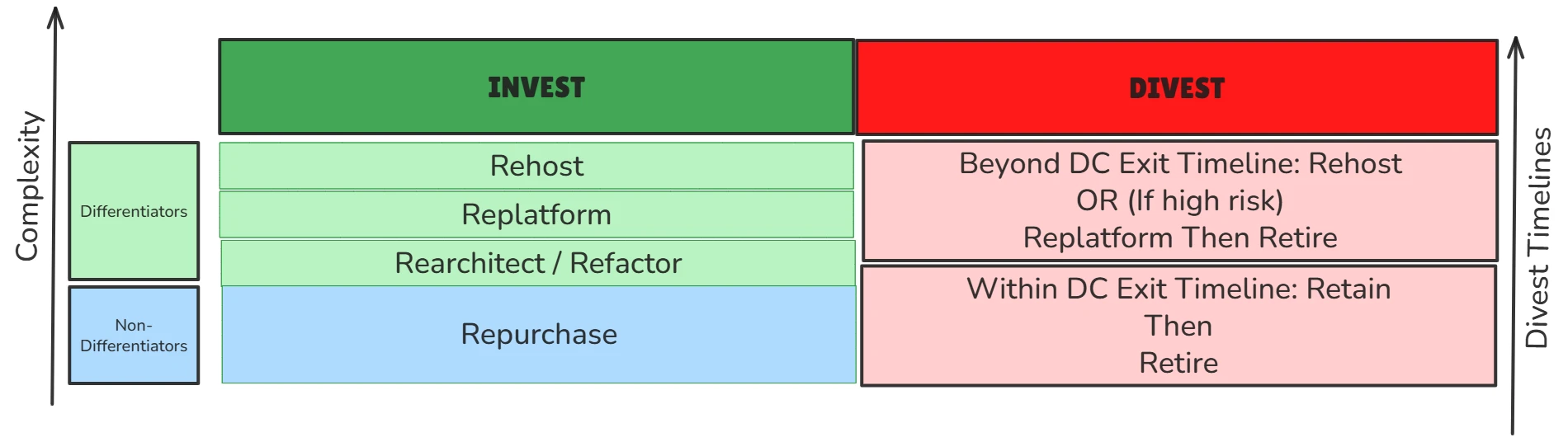
This framework informed strategic migration choices/outcome. Applications were categorised using a three-dimensional model - balancing Complexity, Business Criticality, and Business Differentiation.
Key Challenges and handling approach
Legacy technology
With a tight timeline, it was not possible to re-write / re-architect the application. Where there was vendor support, appropriate escalation path was taken. However, in many instances, only deployable files existed with no vendor support. In such cases, keeping target state (Of Retire and/ore replace) in mind, an uncomfortable decision was taken to lift – shift and redeploy the application with its binaries. In a subset of scenarios, re-platforming to the target state technology was possible (or not due to time constraints). Based on the PoC and execution team’s feedback, the design went through several iterations.
Cloud service readiness
Due to multicloud compliance requirements, there were cases where either (AWS and Azure) cloud services were not quite comparable / identical or corresponding service(s) in the ‘other’ cloud was not ready to be used. It was challenging to prioritise, given engagement of multiple stakeholders (such as security and compliance teams, migration team, and cloud vendors) and tight timelines. Where feasible, easy (but tactical) approach of “least common denominator” was taken, raising technical debts as appropriate. In some situations though, risk of non-compliance, was accepted and recorded in favor of speed of migration. I developed and maintained a (multicloud) service readiness tracker.
Competing stakeholder priorities under tight timelines
We shortened decision cycles via architecture review working sessions, explicit decision logs, and pre‑agreed guardrails (what’s non‑negotiable vs. what can wait). There were instances where teams had nearly irreconcilable positions. We resolved it not only via several calls with engaged stakeholders but following escalation path to get an agreement / approval from sr leadership so that the delivery does not get stalled.
What Made the Difference
Portfolio‑level optimisation: Clustering by business value vs migration effort (with the lens of complexity, dependencies, risk, target state) to land early, visible wins.
Defensible decisions: Every decision linked to a lens, a control, and a measurable outcome.
Feedback‑first platform uplift: Each wave improved controls, automation, and patterns for the next.
Patternisation of Service Usage: Nature of workloads combined with target state technology and execution feedback, service selection decision framework and usage patterns were created that acted as force-multiplier for ongoing migration.
Outcomes and Impact
Portfolio-Level Optimisation
Clustered applications by business value vs. migration effort, enabling measurable wins while managing transformation risk.
Decision Traceability
Every architecture decision became defensible, linked to measurable outcomes and aligned to governance frameworks.
Continuous Learning and Platform Readiness
Feedback from each migration cycle informed enhancements in cloud controls, automation maturity, and design standards.
Impact
The program demonstrated how strategic architecture, structured engagement, and feedback-driven delivery can unlock transformation at scale.
It resulted in significant reduction of technical debt and measurable improvement in the organisation’s modernisation index equivalent to an estimated millions in risk and operational cost reduction across the ~3,000-application portfolio. The programme avoided infrastructure maintenance, renewals and upgrade spends and improved operational efficiency by estimated 40%. Precise figures remain confidential, but the modernisation index improvement was independently validated by governance board.
Through targeted replatforming, infrastructure standardisation, and automation, the initiative strengthened resilience, security posture, and operational efficiency, paving the way for future AI and data-driven capabilities.
Key Learnings
Automate when patterns repeat: Stand up a simple framework to decide if automation adds value for provisioning/deployments. Trigger only when > X workloads share the same pattern.
Do workload-level TCO, not slogans: For “cloud-unfriendly” apps, compare retain/retire/replace vs. lift-and-shift with real run/ops/risk costs before you move.
Make it a three-way collaboration: Infra + Security/Governance + App owners move faster together; bake joint decisions into the cadence so security isn’t an afterthought.
Decide with lenses, document the debt: Use complexity/criticality/differentiation to pick rehost/replatform/refactor; time-box any risk/tech debt and track it.
Run an architecture review cadence, not a gate: Short, frequent working sessions unblock teams and keep designs aligned without slowing delivery.
Use a service parity tracker: Map required services across clouds; choose the least-common-denominator intentionally and record exceptions.
Close the loop weekly: Feed delivery learnings straight into patterns, controls, and the platform backlog: every wave gets easier.
Measure what matters: Track deploy lead time, change fail rate, cost variance vs. baseline, and risk reduction; publish a simple scorecard.
Start with visible wins: Cluster migrations by value/effort to land early outcomes that buy stakeholder confidence.